

How To Install Drywall Ceiling By Yourself
How to Hang Drywall Like a Pro
Get that sheetrock up fast
Introduction
Installing drywall is not rocket science, just information technology volition go faster and wait better if you learn the fundamentals before you outset (instead of after yous're done).
Tools Required
Materials Required
- 1-1/four-in. drywall screws
- 1-5/8-in. drywall screws
- two x 2 (for optional crutch)
- Drywall
- Drywall nails
Drywall is 1 of the easiest-to-use and cheapest structure materials in the world. Fifty-fifty a serious fault volition make you lot chuckle, knowing you've wasted petty time and probably less than five bucks. And the money you save handling the task yourself will come up in handy when furnishing that new room.
Hanging "stone" (short for "sheetrock") doesn't require a lot of finesse, just information technology is heavy piece of work. Just if you are in reasonably skilful physical condition, don't be afraid to tackle one, two or fifty-fifty three rooms on your own. It's sometimes difficult to interest a pro in hanging just a room or two, or even become on the schedule. Too, defining and covering the walls with a finished material can be satisfying.
This how to install drywall article will demonstrate the nuts of hanging drywall. If you do a good job of hanging drywall, the drywall tin can exist taped and finished smoothly and hands. "Taping" refers to the process of filling fastener holes, applying joint tape and three layers of taping compound to seams and corners, and and then sanding. (Read more about drywall taping here.) Poor drywall hanging techniques brand it difficult for even a seasoned taper to deliver a flat, uncracked surface that'south gratuitous of boom pops and ready for paint. We'll show yous the techniques and tools the pros use to get the drywall job done fast and in a style that makes taping equally painless as possible.
Video: How to Record and Mud Drywall
Projection step-by-step (fifteen)
Footstep 1
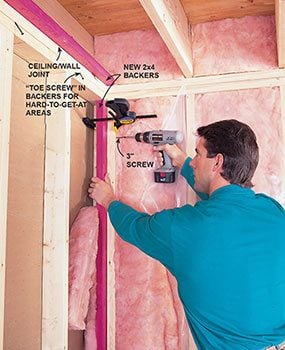
Fasten Backers at Corners
- Fasten wood backing wherever drywall ends have no back up within 4 inches.
- Note: Make sure to check corners and ceiling/wall joints.
Footstep two
Mensurate Advisedly
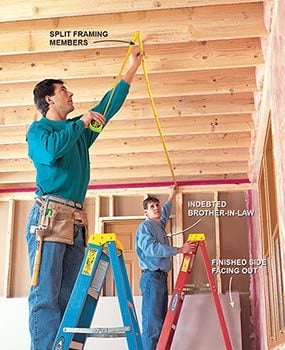
- Measure out from the end of the ceiling to the centre of a joist and cut the sheet to length.
- Pro tip: Stop cuts should split up framing members. Gaps at ends and splices should be less than one/4 inch.
- Mark fastening guidelines every 16 inches from the cease of the sheet with a drywall square.
- Cut overall lengths 1/four inch shorter for easier fitting.
Selecting Drywall
Most drywalling calls for 3 basic types and thicknesses of textile:
- Half-inch for framing spans of 16 inches or less.
- Five-eighths-inch for spans up to 24 inches on ceilings. The 5/8-inch drywall is also called Type 10 or fire-resistant. It is used in areas where a firewall is required, such as between a house and an attached garage. Consult your local edifice official for installation specifics.
- Half-inch drywall that'south water-resistant for humid areas such as baths (boiling, not wet). This material is non adequate for ceilings or areas such as tiled shower enclosures. Mold-resistant drywall is likewise sold for areas like basements where mold might be a concern.
Door and window jambs and electric outlets are ordinarily set for i/ii-inch drywall, so bank check to confirm. Three-eighths-inch and 1/4-inch are bachelor too only are rarely used except on curved wall surfaces or areas where thinner stone is required. For case, if you're patching old plaster walls, three/8-inch may exist the only thickness that will lucifer the depth of the plaster.
Drywall usually comes in either 4x8 or 4x12 sizes. If you live in an area large plenty to back up a commercial supplier, information technology'll offering more variety than an boilerplate lumberyard. It may accept 9-, x- and xiv-human foot lengths, 54-inch widths for 9-foot. ceilings and odd things similar flexible drywall for curved surfaces. Drywall lengths don't radically affect overall textile cost. If you lot think you can handle 12-pes. sheets (and if they'll fit through the stairwells), they're the mode to go. You'll have far less waste material and fewer seams to record. Go on in mind that a 4x8 sheet weighs 55 lbs. and a 12-footer most 82 lbs.

Step iii
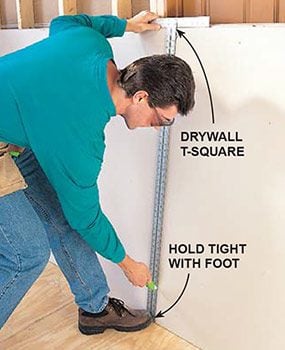
Score the Drywall
- Measure the length needed and score the paper face with a utility knife, using a drywall square as a straightedge.
Step iv
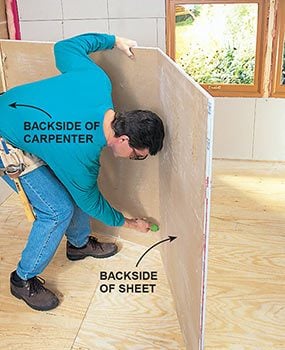
Snap the Drywall
- Snap the sheet, fold it open and cutting through the newspaper on the backside.
Footstep 5
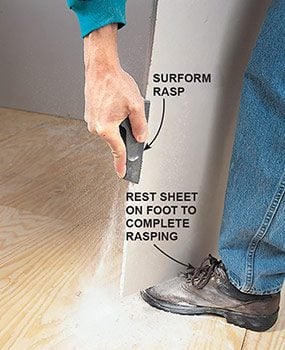
Smoothen the Edges
- Shine crude edges on cut ends with a Surform tool to ensure tight joints.
Using a Drywall Lift
Drywall is heavy stuff, so consider saving your back by renting a drywall lift for a day. A lift is fantastic if yous're shorthanded or installing 12-foot sheets. Information technology disassembles easily, weighs near 75 lbs. and will fit in a minivan or modest pickup. A lift makes information technology possible to hang rock solo, but information technology's nevertheless nice to have a helper for loading the rock onto the elevator. A elevator tilts from vertical to horizontal. Wheels permit you to whorl it upwardly to the drywall stack, load a sheet onto the rack, roll information technology back into position and creepo the sheet up into identify. Although a elevator can also exist used for wall placement, its potent suit is ceilings.
Step vi
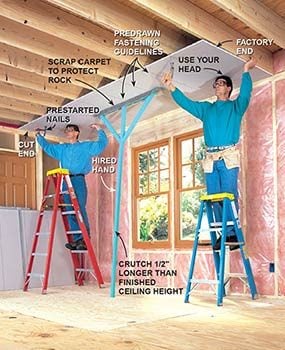
Tack the Canvass in Place
- Hoist the ceiling sheets overhead and tack them into identify using a "crutch" made of 2x2s to support the lion'due south share of the weight.
- Prenail and position the sheet, tacking it to the joists.
Step vii
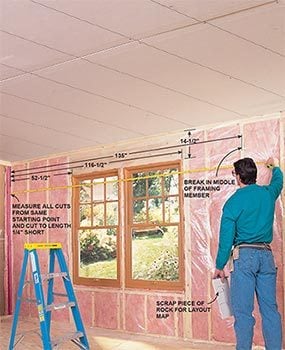
Measure out the Upper Sheet
- Measure the distance from a wall corner to the heart of a framing member, also recording distances for cutouts and door and window openings.
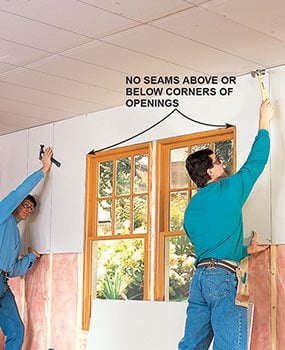
- Pro tip: Avoid placing joints over doors and window corners, where they may crack.
Step viii
Cut the Openings
- Cut window and door notches from a single sheet by sawing sides with a drywall saw.
- Pro tip: A keyhole saw is slower, simply information technology is an acceptable substitute for long cuts.

Footstep 9
Finish the Cut
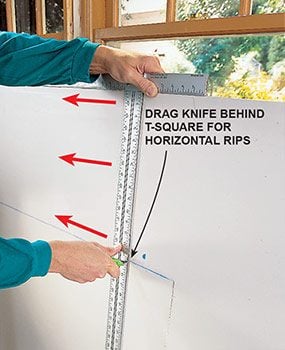
- Score the third side of the notch with a utility pocketknife.
- Snap the section loose and consummate the cutting from the backside.
- Pro tip: For quick rip cuts, elevate your utility pocketknife behind the T-foursquare as yous slide it along the meridian (nestle the blade of the knife against the ruler role of the foursquare).
Step 10
Hang the Acme Canvas of Drywall
- Lift the summit wall canvass, holding it tight confronting the ceiling, and tack it into place with nails.
- Pro tip: This canvas should exist pushed tight against the ceiling before fastening. Never break joints at the edge of a window or door. These seams will somewhen crack, and the buildup of taping materials will brand installing casing difficult.
- Pro tip: Don't forget to mark fastener guidelines before lifting.
Step 11
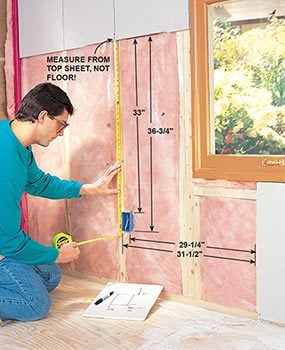
Measure Cutouts
- Mensurate electrical box cutouts from all four sides.
- Cheque all layout measurements twice before cut!
Step 12
Mark and Cut the Drywall
- Transfer measurements to the drywall.
- Cut the outlet box openings with a keyhole saw.
- Pro tip: Take special intendance in planning and sawing cutouts for electrical boxes because if you miss, that oversized outlet hole is a bear to set. Fixing a poorly cutting or overcut hole is catchy, and the repair will never look quite right.

Spiral Cutout Saw
Although we don't prove one in use here, pros now use spiral saws to cut openings for outlets, lights and even doors and windows. The bones idea is easy: Just marking the approximate center of the outlet or light, hang the canvas of drywall, and and then poke the thin screw chip through the center mark and follow the edge of the fixture all the way around. For door and window openings, hang the canvass across the opening and then follow the framing with the screw scrap—no measuring required, and you get a perfect cut every time. Of course, it takes a picayune practice to go the hang of the tool, it kicks upwardly a lot of dust, and the basic tool costs $lxx to $100, merely if y'all're doing more than i room information technology may be worth the investment. For more information, see How to Use a Spiral Saw on Drywall
Pace 13
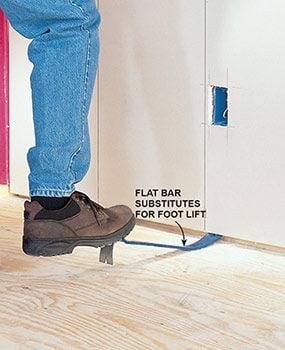
Lever Bottom Drywall Sheet into Place
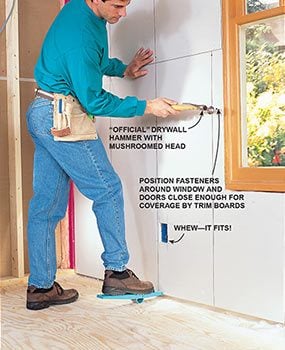
- Hoist the bottom sheet with a pes lift or flat bar and tack it into place.
- If an opening needs pocket-sized adjustments, shave the edges with your utility pocketknife.
Step 14
Finish Fastening with Screws
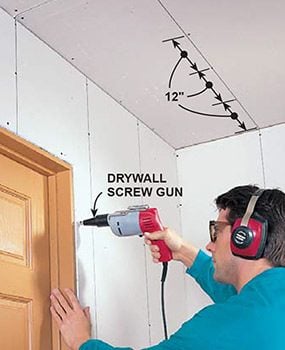
- Screw ceiling and walls with a screw gun.
- Pro tip: Use five fasteners per framing member, one in each tapered edge and iii more spaced evenly every 12 inches. Slightly angle screws on the ends of sheets, where there is merely iii/4 inch of woods left to catch screws. If yous run them in too shut to the terminate, the drywall core will suspension and they won't concur well.
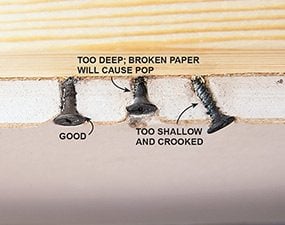
- Gear up screws and nails slightly below the surface of the paper, being careful not to break through into the gypsum cadre.
- To hide the fasteners, position them close to openings around windows and doors so the trim will embrace them.
- Pro tip: Use ane-i/4 inch fasteners for i/2-inch rock and 1-5/8 inch fasteners for five/8-inch rock. Longer screws and nails are more prone to nail pops. Use every bit few nails as possible and merely to tack up the sheets until you tin go the screws in.
Stride xv
Check for Protruding Screws
- Afterwards installing all the drywall, drag a putty knife over every single fastener.
- Note: If you hear a click, you've institute a rogue fastener that needs to be prepare. Practise not employ your hammer to fix a protruding screwhead — this may break the screw, creating a bigger hole to patch, and will crusade a boom pop in the hereafter.
- When you notice a protruding screwhead, screw information technology in a little more with a screwdriver or a cordless drill.
- Remove any fasteners that missed the framing member.

More than Drywall Hanging Tips From the Pros
- Don't try to salve a couple of bucks by using scraps of drywall when you should be using a full sheet. The time and endeavour spent taping extra joints is rarely worth the money saved.
- E'er join tapered edges to tapered edges.
- Stagger seams with each row of rock.
- Recall ahead to make taping equally like shooting fish in a barrel as possible. Remove cleaved corners and loose chunks of rock, and cutting out any blisters. These volition all be filled in subsequently with a fast-setting joint chemical compound.
- Never use tapered edges for outside corners where corner bead goes. The thinner edge of the drywall makes it difficult to properly fill the beaded border with taping compound.
- As your final task, run a putty knife over all screwheads and fix all fasteners below the surface. Since you put them in, it's your job (not the taper'due south) to brand sure they're properly set up. Tapers go very upset when they have to spend half of their first day on the job repairing improperly fix fasteners. And the taper might be yous.

Source: https://www.familyhandyman.com/project/how-to-hang-drywall-like-a-pro/
Posted by: lawrenceabightly.blogspot.com
0 Response to "How To Install Drywall Ceiling By Yourself"
Post a Comment